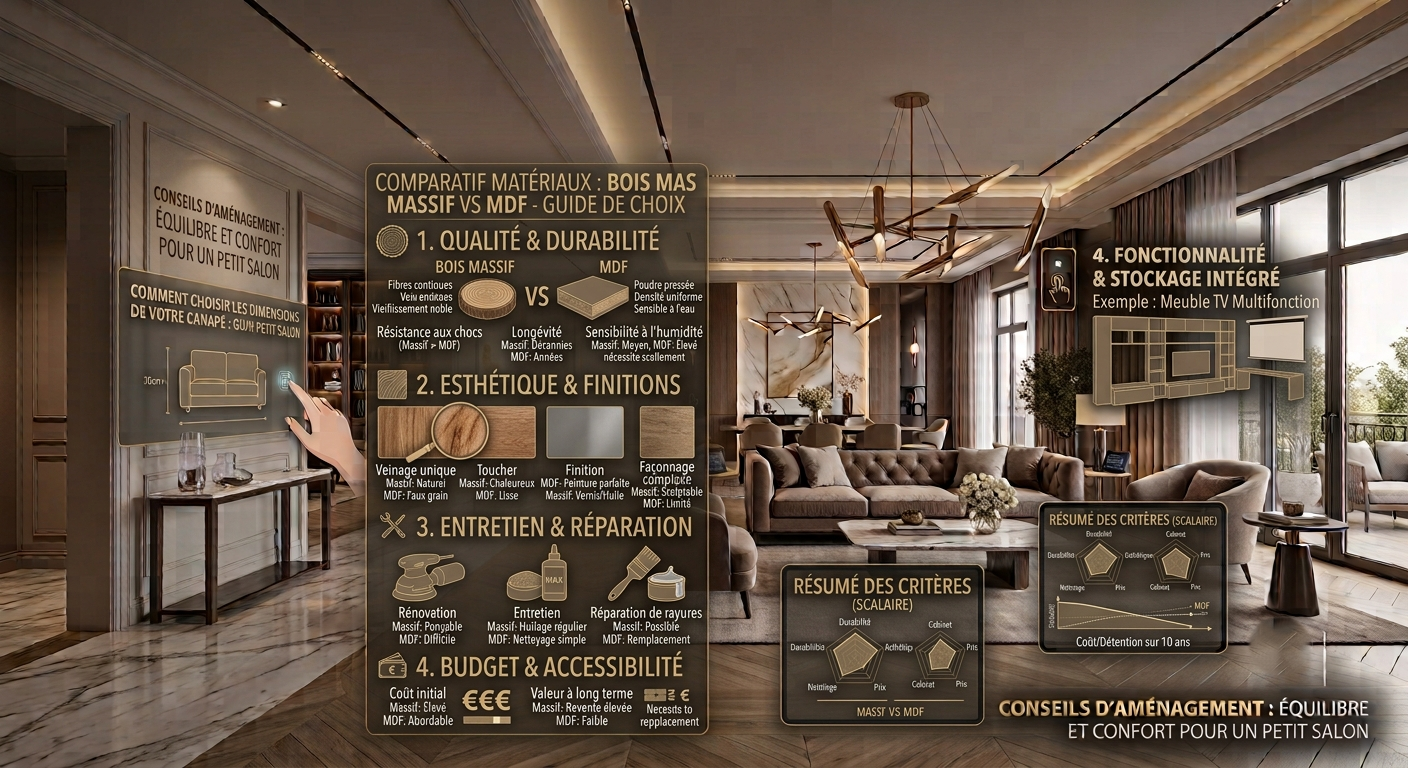
Solid Wood vs MDF: What's the Difference and Which One Should You Choose?
The choice of materials is the most determining decision when acquiring furniture. Among the most frequent options on the furniture market, solid wood and MDF (Medium Density Fiberboard) often compete. Although very different in their composition and uses, each has specific advantages. Discover our complete guide to understanding the differences between solid wood and MDF, and make the ideal choice for your luxury interior.
What is Solid Wood?
Solid wood refers to wood exactly as it is extracted from the tree, without any chemical transformation or addition of composite materials. It is the noble material par excellence. Each piece of solid wood has a unique grain, color, and texture. Species such as oak, walnut, beech, or mahogany are particularly prized in the manufacture of high-end furniture for their robustness, timeless aesthetics, and the natural warmth they exude.
What is MDF?
MDF, or Medium Density Fiberboard, is an engineered wood. It is made from recovered wood fibers, mixed with a synthetic resin, and compressed under high pressure and high temperature. The result is a perfectly smooth, dense, and isotropic board (without grain or knots). MDF is highly appreciated in modern furniture because it does not warp easily, can be cut with surgical precision, and offers an ideal surface for lacquering, painting, or veneering.
Complete Comparison
Strength
Solid Wood: Unquestionably superior in terms of structural strength. A solid wood piece of furniture can support very heavy loads and withstand major impacts without breaking.
MDF: Very dense, it is strong but has a structural weakness if subjected to excessive bending stress. Moreover, it is more susceptible to screw pull-out if assembled and disassembled frequently.
Durability
Solid Wood: Its lifespan is measured in decades, even centuries. It can be sanded, repaired, treated, and revarnished infinitely. It withstands time and develops a magnificent patina.
MDF: If well maintained and if it is high-density MDF, it can last for many years. However, in case of deep damage, it is almost impossible to repair (it cannot be sanded like solid wood).
Aesthetics
Solid Wood: Unmatched for its raw charm. The veins, knots, and color variations make it a living material. It is the signature of authentic craftsmanship.
MDF: Its main asset is its smooth perfection. It has no irregularities, making it the preferred material for flawless lacquered finishes (matte or glossy) and ultra-contemporary design.
Maintenance
Solid Wood: Requires regular maintenance. It must be nourished (wax or oil) to retain its shine and protected from extreme temperature and humidity variations to prevent cracking.
MDF: Very easy to maintain. If its surface is painted or lacquered, a simple damp cloth is enough to clean it.
Moisture Resistance
Solid Wood: Wood is hygroscopic: it absorbs moisture and can swell, or shrink in a dry environment. A water-repellent treatment is essential in damp rooms.
MDF: Standard MDF is extremely afraid of water (it swells and irreversibly disintegrates if immersed). However, there is moisture-resistant MDF (usually dyed green) specially designed to withstand humidity.
Price
Solid Wood: A luxury material, its price is naturally higher. It depends on the rarity of the species, the drying time, and the artisanal work it requires.
MDF: Much more accessible. It is an economical solution that allows complex designs at a lower cost.
Which Material to Choose According to Your Project?
Living Room
The living room is the showcase of your interior. For a sculptural coffee table, a majestic large bookcase, or a sideboard, solid wood will bring incomparable prestige and warmth. For minimalist design TV stands requiring perfect lacquers, MDF is often preferred.
Bedroom
For a bed frame, solid wood is highly recommended for its robustness. On the other hand, for a very large wall-mounted wardrobe with perfectly smooth doors, MDF is ideal because it will not warp over time and lightens the structure.
Home Office
An executive desk commands respect and seriousness: solid wood (walnut or oak) is the quintessential choice here. For additional storage and shelves with a sleek design, wood-veneered MDF offers an excellent compromise.
Kitchen
The kitchen is a hostile environment (humidity, heat). Cabinets are usually made of particleboard or moisture-resistant MDF. For luxury facades, solid wood or very high-density lacquered MDF is often chosen.
Misconceptions about MDF
It is common to think that MDF is "cheap" or of poor quality. This is false. In the high-end furniture sector, a very high-density MDF (HDF) is used, which is extremely resistant. Most Italian lacquered designer furniture sold at premium prices is made of HDF, because it is the only material that achieves this surface perfection, without the risk of the lacquer cracking (unlike solid wood which "moves").
Why BR Décor Selects the Best Materials
At BR Décor, we refuse compromises. When we work with solid wood, we select noble species, perfectly dried and environmentally friendly, magnified by the know-how of our cabinetmakers. When the design requires MDF (for deep lacquering or specific curved shapes), we exclusively use premium moisture-resistant High-Density MDF. Our goal is to combine the beauty of design with flawless durability.
Tips Before Buying Furniture
- Always check the weight: very light furniture is rarely synonymous with quality, whether wood or composite.
- Observe the edges: this is where the finish betrays the quality of the MDF panel.
- Ask if the MDF meets E1 or E0 standards regarding formaldehyde emissions (for healthy indoor air).
- For solid wood, inquire about the species and the type of treatment applied as a finish.
FAQ
Absolutely. It is actually the standard in quality furniture: solid wood structures or legs for strength, and large wood-veneered MDF panels for stability (they do not warp).
Older MDF used glues that emitted formaldehydes. Today, the premium quality MDF used by BR Décor meets very strict environmental standards and is safe.
At equal thickness, MDF is often heavier than solid wood because it is extremely dense, composed of compressed fibers and resins.
Yes, but it would be a shame to hide its veins. If you want an opaque painted piece of furniture, MDF is a much wiser and more economical choice.
Less well than solid wood. That's why at BR Décor, we use specific assembly systems and reinforced dowels when working with MDF.
Conclusion
The match between solid wood and MDF has no absolute winner. Solid wood seduces with its soul, its nobility, and its secular lifespan. MDF stands out for its stability, surface perfection, and versatility in contemporary design. The best choice will therefore depend on the desired design, the use of the furniture, and your budget. By consulting experts like BR Décor, you are assured of being guided towards the ideal material for your luxury project.
Explore the Quality of Our Projects
Un projet de décoration en tête ?
Discutons-en directement sur WhatsApp.